
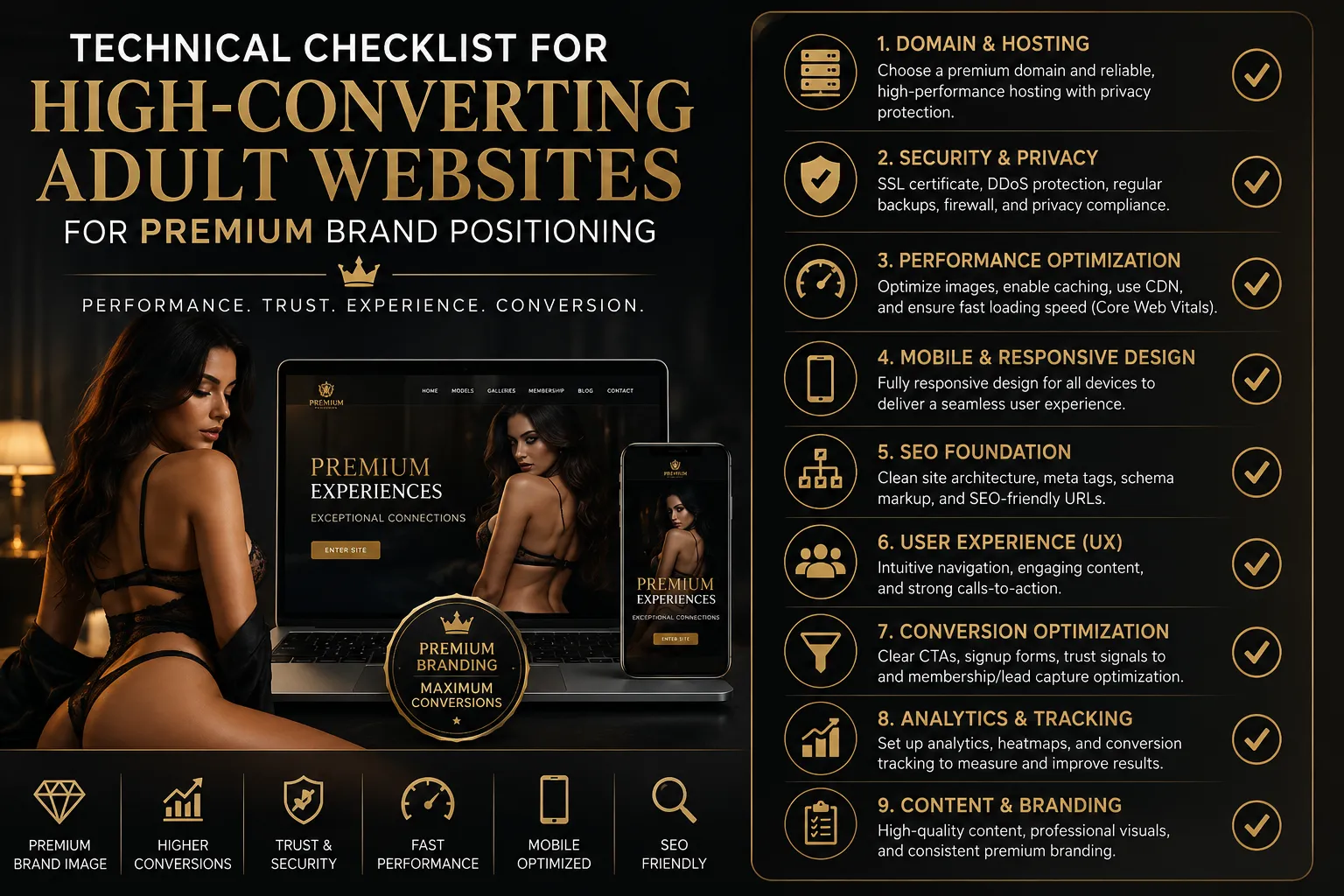
Published by Escort Marketing Agency (EMA) | Branding & Trust Series
Most conversations about adult brand growth start in the wrong room. Marketers focus on traffic, operators chase conversions, and designers argue about color palettes — while the structural foundation that makes any of it matter quietly goes unaddressed.
The reality is that in a category where consumer skepticism runs higher than almost any other vertical, trust is not a brand value you can list in your “About” section. It has to be engineered into your website at the technical level, one deliberate decision at a time.
This isn’t a content strategy piece. It’s a discipline-by-discipline breakdown of what separates an adult brand website design that functions as a legitimate business asset from one that leaks credibility the moment a visitor arrives.
Whether you’re an independent operator, an agency scaling a portfolio of premium brands, or an established platform rethinking your digital identity, the checklist below addresses the technical decisions that directly influence how professional — and trustworthy — your presence appears to both people and search engines.
The Architecture of Perceived Professionalism
Before a single visitor reads your copy, their browser has already made several quiet assessments about your site. Response time, certificate validity, redirect behavior — these aren’t just performance metrics. They are the digital equivalent of a first handshake, and a weak one communicates something your brand may never recover from in that session.
HTTPS is baseline, obviously. But what’s less commonly discussed is the distinction between a correctly configured SSL certificate and one that’s technically present but triggering mixed-content warnings or displaying an outdated issuer.
Browsers flag these quietly, but visitors notice the padlock behavior, and that small visual cue does significant work in a category where data sensitivity is a genuine concern. Every asset on a premium adult website — images, scripts, fonts, third-party embeds — must load over secure connections. A certificate that’s 90% correct is, from a trust standpoint, entirely incorrect.
Domain structure also communicates authority in ways operators underestimate. A branded custom domain with a clean TLD reinforces permanence. Subdomains used carelessly fragment brand equity.
Redirect chains, especially those involving HTTP-to-HTTPS transitions layered over WWW/non-WWW inconsistencies, create crawl confusion and signal to experienced users that the back-end is sloppy. These aren’t hypothetical concerns — they show up in audit after audit for brands that describe themselves as premium while tolerating infrastructure that contradicts the claim.
Page Speed Is a Trust Signal, Not a Vanity Metric
The relationship between load speed and bounce rate is well-documented, but in the adult vertical, it carries a specific emotional dimension. Visitors to these sites often arrive with heightened caution.
A site that hesitates — that keeps someone waiting on a blank white screen for four seconds — gives that caution time to calcify into departure. You lose them not because your offer was wrong, but because your technical execution made the space feel unsafe.
Core Web Vitals now inform both search visibility and real-world experience quality. Largest Contentful Paint, Cumulative Layout Shift, and Interaction to Next Paint are not abstract developer concerns. A hero image that renders late causes a layout jump that makes a page feel unfinished. A slow server response time — anything above 200ms at the TTFB level — quietly erodes the sense of operational care that premium positioning requires.
Practical fixes here aren’t exotic. Images served in next-generation formats (WebP, AVIF) rather than legacy JPEGs reduce payload significantly without visible quality loss. A properly configured CDN with edge nodes close to your primary audience reduces geographic latency.
Eliminating render-blocking JavaScript by deferring non-critical scripts improves perceived load time more than almost any other single change. These aren’t “nice-to-haves” for a brand competing at the premium tier — they’re admission criteria.
Mobile UX as a Reflection of Brand Respect
Responsive design in 2025 is not a differentiator. It’s a requirement. But there’s a meaningful gap between a site that renders without breaking on a mobile screen and one that was genuinely designed to function beautifully on one. That gap is where most adult brands currently live, and it’s wider than the industry acknowledges.
Touch target sizing matters. A navigation element, call-to-action button, or profile card that requires precise stylus-like accuracy to tap communicates, at a subconscious level, that whoever built this did not imagine a real person using it. On mobile viewports, interactive elements should meet the 44×44 pixel minimum — not because Google says so, but because it signals that a human being thought carefully about the experience.
Font scaling is another friction point that reveals design maturity. Body copy that renders at 10px on a standard mobile device forces users to pinch and zoom, which — particularly on a site where discretion matters — is an experience most will abandon rather than work through.
Type that reads clearly, whitespace that gives content room to breathe, images that don’t overflow their containers: these are not aesthetic preferences, they are statements about how seriously a brand takes its audience.
Structured Data and Schema: The Quiet Authority Builders
Very few adult websites invest in structured data implementation, which is precisely why it represents a meaningful competitive surface for brands willing to do the technical work. Schema markup communicates to search engines what your content is, who created it, and how it should be understood — and when implemented correctly, it can influence how your pages appear in organic results in ways that pure on-page optimization cannot.
For service-oriented adult brands, the LocalBusiness or Organization schema provides the foundational layer. Adding Review or AggregateRating schema where applicable creates rich results that increase click-through rates in contexts where those results are served. BreadcrumbList schema reinforces site hierarchy and helps search engines understand content relationships across deep URL structures.
The reason this matters for trust — not just visibility — is that structured data signals long-term investment. Sites that have taken the time to implement and maintain schema markup don’t read like temporary operations. They read like businesses. In a category frequently associated with short-lived domains and low-effort technical execution, that distinction compounds into meaningful brand differentiation over time.
Privacy Infrastructure as a Competitive Advantage
Privacy compliance in the adult sector is not a legal checkbox exercise. It is, in the current regulatory environment, one of the most credible trust signals a brand can offer. GDPR obligations, CCPA requirements, and the expanding patchwork of state-level data regulations mean that how a site handles user data now speaks directly to how it values its users.
A privacy policy that was copied and pasted from a template generator and last updated in 2019 undermines credibility in ways a potential client can feel, even if they can’t articulate the specific reason. A clearly written, current, and specific privacy document — one that explains exactly what data is collected, why, how it’s stored, and how users can request its deletion — communicates organizational maturity.
Pair that with a properly configured consent management platform that handles cookie permissions correctly across jurisdictions, and you’ve separated your brand from the significant majority of competitors who treat privacy as an afterthought.
This is also where technical implementation and brand positioning intersect in ways that directly affect revenue. A well-configured CMP does more than achieve compliance — it collects consent in a way that enables you to build a first-party data asset. In a post-third-party-cookie landscape, that asset is one of the most strategically valuable things an adult brand can own.
The Anatomy of a High-Trust Contact and Conversion Flow
If the rest of your technical infrastructure communicates stability and care, your conversion flow must sustain that impression to the point of action. This is where most adult websites fail most visibly, and where the revenue impact of poor trust-focused adult web design is most immediate.
Form design matters enormously here. Long, ambiguous inquiry forms that request information the visitor can’t understand the purpose of create friction that erodes trust right at the moment it matters most.
Short, purposeful forms — ideally with clear explanations of what happens after submission, how quickly a response should be expected, and what data is retained — convert at meaningfully higher rates. The contrast between a contact form that feels like a professional intake process and one that feels like a data collection exercise is felt immediately.
Confirmation and follow-up communication infrastructure is equally important. An automated email confirmation that arrives within seconds, formatted cleanly with a branded header and a clear summary of what the inquiry covered, communicates operational competence.
Its absence communicates the opposite. This is not complex to implement, but it requires someone to have thought deliberately about the post-submission experience, which, surprisingly, most operators in this space have not.
If your current web presence isn’t doing justice to the brand experience you’ve built offline, our adult web design services are specifically structured around resolving that gap. The technical foundation described throughout this piece — the speed architecture, privacy infrastructure, structured data, mobile UX, and conversion flow design — represents exactly the scope of work EMA approaches when rebuilding or refining digital presence for premium adult brands.
Analytics and Technical Monitoring as Ongoing Brand Protection
A website is not a product that ships and stays stable. It is a living technical system that degrades if not maintained — and in the adult vertical, where tracking infrastructure is particularly prone to third-party policy changes and platform restrictions, the maintenance burden is higher than in most categories.
Google Search Console and Bing Webmaster Tools should be configured for every branded domain with ownership verified, sitemap submitted, and crawl errors monitored on at least a weekly cadence. Index coverage reports frequently reveal surprises: pages excluded by misconfigured robots.txt directives, soft 404 errors that are damaging crawl budget, duplicate content issues created by URL parameter handling that was set up for functionality reasons but never optimized for search.
Server-side analytics — particularly in an era of increasing ad blocker adoption — give a more accurate picture of traffic behavior than browser-side JavaScript implementations alone. For a premium brand making positioning decisions, the difference between reported and actual traffic can be material. Knowing your real numbers, not just the ones your analytics tag captured, is a strategic advantage.
Uptime monitoring with sub-minute check intervals and immediate alerting is non-negotiable for any brand that treats its digital presence as a primary business asset. A site that goes down at 11 pm on a Friday and isn’t noticed until Monday morning has spent an entire weekend eroding client confidence in ways that take months to repair.
Security Architecture as Brand Statement
The final layer of this checklist is the one most commonly deferred until something goes wrong. Security infrastructure — properly configured, actively maintained — is not just protection against breach. It is, for premium adult brands, an active component of the trust argument.
A web application firewall that filters malicious traffic before it reaches your server keeps both user data and site integrity protected. Regular penetration testing — at least annually for any site handling financial transactions or personal information — identifies vulnerabilities before they become incidents. Strong password policies and two-factor authentication on every admin account are hygiene, not enhancement.
For brands handling payments directly, PCI DSS compliance is not optional, but beyond compliance, the choice of payment processor communicates a great deal. Recognizable, stable payment infrastructure with branded security seals at checkout reinforces the legitimacy signal at exactly the point where a visitor is making a financial commitment to your brand. The last thing a premium positioning strategy can afford is a checkout experience that feels precarious.
Closing Perspective
The technical checklist above isn’t aspirational. Every item on it is currently implemented by the adult brands that are growing fastest, retaining clients most effectively, and commanding the rate premiums that come with genuine premium positioning. None of it requires exotic technology or indefinite budgets. It requires discipline, deliberate planning, and a willingness to treat digital infrastructure as a core brand investment rather than a support function.
At Escort Marketing Agency, we work exclusively within this vertical, which means we’ve seen — in granular detail — the correlation between technical execution and brand performance. Sites that get this right don’t just rank better. They convert better, retain better, and build the kind of reputational equity that compounds into sustainable business growth.
If you’re ready to close the gap between the brand you’ve built and the digital presence that represents it, the conversation starts with an honest audit of where the technical gaps currently live.
Escort Marketing Agency (EMA) is a specialist digital marketing and web development firm serving adult entertainment brands seeking professional, trust-forward positioning in competitive markets.