
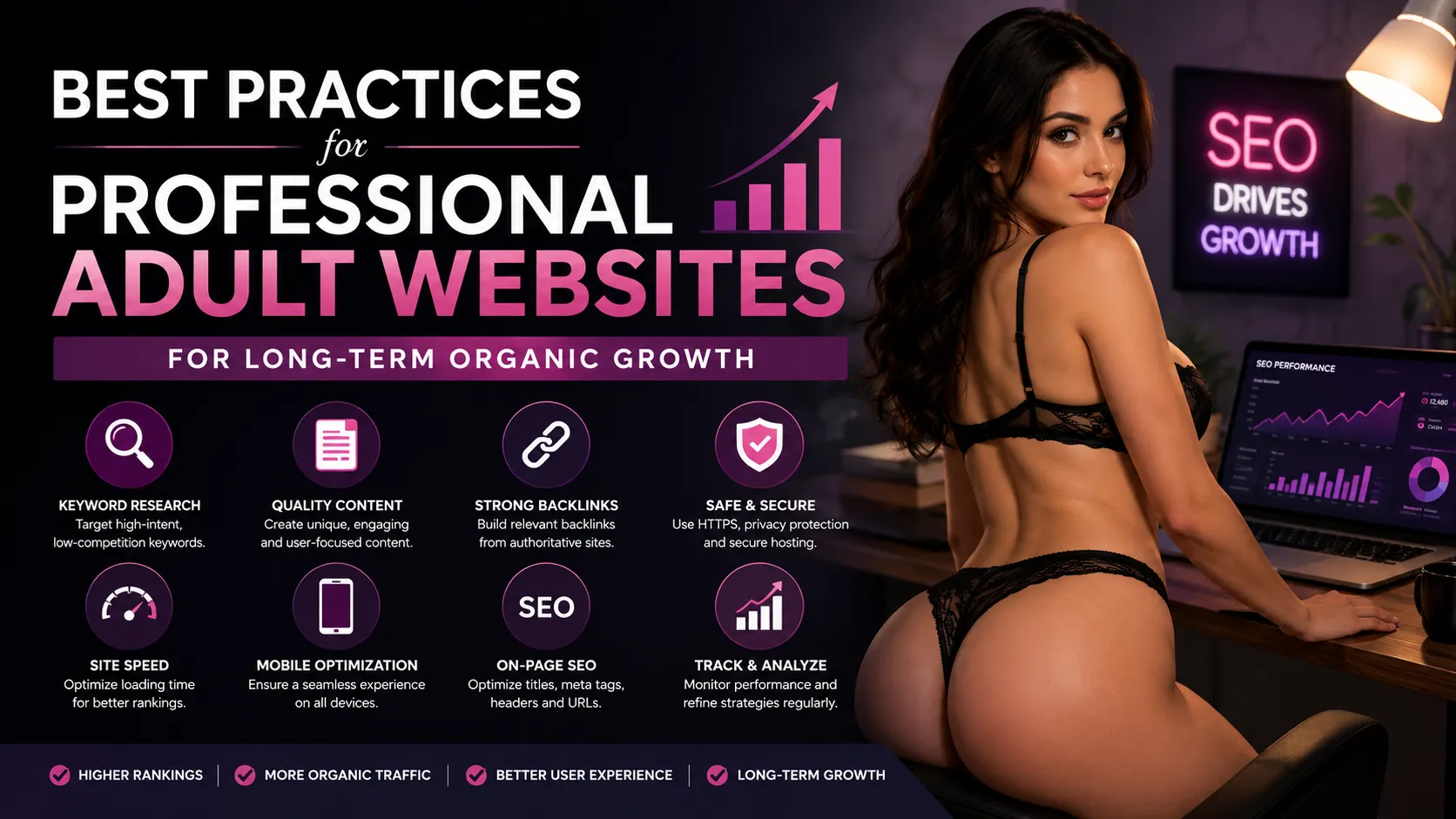
Excerpt – This post discusses how having a rational design and development strategy turns an adult eCommerce platform into a self-sustaining revenue engine – without shortcuts, tricks, or forfeits.
The adult industry makes billions of dollars in revenue worldwide, and a majority of the businesses in this niche are missing out on a ton of money — but not making it because of what they are offering, it’s because of how their website is built, structured, and discovered. Today, in the competitive digital environment, a business’s online adult ecommerce solution is not just a storefront, but it is a strategic business asset that can help to create organic, sustainable growth.
If you’re getting your traffic from paid sources or organic traffic is like a lottery, the issue is likely at the design and development level. Instead of short-term visibility strategies, operators who invest in thoughtful adult e-commerce website design are setting themselves up for long-term success, increased customer loyalty, and robust search performance.
In this domain, user expectations are met, and technical standards are upheld, resulting in the design of experiences that search engines value and that people are likely to recall. This makes a website more than just a transactional environment, instead making it a trustworthy place to go where value is added over time.
If you are an operator, founder, or digital marketer, you are looking for a serious approach to adult ecommerce web design. No fluff, no shortcuts—the honest, long-term perspective on practices that make a difference.
Why Website Design Is an SEO Variable, Not an Afterthought?
There’s a myth circling around in the adult industry that when it comes to SEO, it is only about creating backlinks using keywords to drive link juice. But in reality, Google’s ranking signals have nowadays become intensely entwined with the user experience signals – bounce rate, time-on-site, Core Web Vitals – and all of these are direct products of the design and development decisions. A visually messy websites with lagging loading speed not just irritate visitors, but it also indicates to search engines that your platform is not worth endorsing.
When it comes to adult e-Commerce platforms, it is important to note that they carry an added layer of intricacy. Numerous advertising networks forbid or ban adult content. Now this clearly suggests that organic search is not just a nice-to-have – it has now become a primary and justifiable acquisition channel. Having said all these, this clearly raises the stakes for every decision related to the design of the website.
- 53% of users bounce back from a site that takes over 3 seconds to load on mobile
- 70%+ of adult site traffic now reaches via mobile devices
- 3× higher conversion rate on sites with organized navigation vs. flat layouts
Redesign for a Different User: Design with Users in Mind
Prior to considering colors, product photography, or homepage banners, you have to take into account a site structure that spreads authority cleverly. This would mean that there is a logical structure (a broad category page followed by subcategories followed by a product/content page) that all pages have clean, keyword-rich URLs.
Adult eCommerce sites are treated the same way as any big catalog and are crawled using the same principles. Without internal linking, your deepest pages might not be indexed, no matter how high-quality they are.
Make the hierarchy of the site as level as possible, and no vital page should be more than three clicks from the home page. Implementing breadcrumb navigation can also help users navigate and result in rich breadcrumbs within Google’s search results.
“A platform built on solid information architecture outperforms one with a better marketing budget. Structure is the foundation that all other SEO work sits on.”
Technical SEO Built into the Build, Not Bolted On
One of the most common and costly mistakes in adult e-commerce website design is treating technical SEO as a post-launch checklist item. By the time developers are retrofitting canonical tags, fixing duplicate content issues, or restructuring URL slugs, the site has already accumulated problematic crawl signals.
The right approach embeds technical hygiene into the development process from day one. This includes proper implementation of canonical tags across product variant pages, hreflang attributes if you serve multiple regions or languages, structured data markup for products and reviews, and XML sitemaps that are actively maintained as your catalog grows. Equally important is ensuring that no page intended for users is blocked in your robots.txt — a surprisingly common issue on e-commerce sites that grows in a modular, piecemeal way.
- Canonical tags on all product variants and paginated pages to prevent duplicate content dilution
- Schema markup (Product, Review, BreadcrumbList) for enhanced SERP visibility
- XML sitemap segmented by content type and submitted to Google Search Console
- Robots.txt audited to ensure high-value pages are not inadvertently blocked
- HTTPS is enforced sitewide with properly configured 301 redirects from all HTTP variants
- Structured internal linking between thematically related categories and products
Page Speed and Core Web Vitals: The Inflexible Floor
Adult ecommerce websites have a natural inclination to be image and video-heavy. This is one area where optimizing for performance is more challenging than in other kinds of content, and is a bigger advantage when you do get it right. Next-gen image formats (WebP, AVIF), CDN delivery, and lazy loading are expected to be basic features, not high-level techniques.
Focus on Largest Content Paint (LCP), which is mostly related to the time your above-the-fold hero image or thumbnails load. Another common issue with catalog pages that have images that are not specified in dimensions is Cumulative Layout Shift (CLS). Addressing these is not only about ranking on Google, but it is also about making sure that people do not leave your site without making a purchase.
Mobile-First Is Not a Trend — It’s the Market Reality
Adults spend more than two-thirds of their time watching adult content on their cell phones. However, many adult e-commerce websites are still built for desktop, and then forced to fit into the mobile environment, with all the awkward tap targets, product descriptions cut off if they’re too long, and checkout processes that simply stop working on smaller screens.
Mobile First” takes the approach of creating the mobile experience as the first experience and scaling up to larger viewports. No zooming required for the typography. A navigation menu should be able to be accessed by pointing with one thumb.
Product images should be able to be swiped over without having to pinch to zoom. Each touchpoint that’s further down the funnel in the buyer’s journey decreases the likelihood of conversion — and that’s even more pronounced on mobile.
On-Page SEO for Product and Category Pages
Product pages are the pages that might be the most poorly optimized pages on adult ecommerce sites, and have the most commercial intent. A meta description is not going to convert long-tail searches, and long-tail keywords have lower search volumes and less competition, so adult e-commerce sites can actually compete with larger sites.
The title tags of each product page should be different and should correspond to the intent of a potential purchaser when searching for one of these items. The H1 should be identical to the main keyword, but should sound natural. Product descriptions must be more than just a two-sentence filler, and should be 150-300 words of valuable, original copy.
The same applies to categories: a 200-word category introduction that includes topical keywords provides search engines with a lot more “signals” as to what the page is about than a blank category header and thumbnails in a grid.
- Unique title tags: Every product page needs a distinct, keyword-aware title. No templates or auto-generated strings.
- Category introductions: A 200-word topical intro on each category page builds semantic relevance that product grids alone cannot.
- User-generated signals: Reviews, ratings, and Q&A content add freshness and long-tail keyword diversity without editorial overhead.
- Internal linking depth: Cross-linking related products and complementary categories distributes authority and reduces orphaned pages.
Content Strategy: Creating Topical Credibility Over Time
In competitive niches, topical authority has emerged as one of the most important search engine ranking factors. The search engines also determine whether the domain, in general, covers a subject well.
It’s a real opportunity for adult e-commerce sites to develop a structured content hub on a topic that’s relevant to them, but also shares information. It’s an opportunity for adult e-commerce sites to build out a structured website around a topic that’s relevant to them but also information-rich, which can help enhance the ranking power of your transactional category and product pages.
This is not to imply sensationalist or explicit material. Buying guides, care and maintenance articles, lifestyle features, and educational resources all help to build topical authority and maintain a professional tone in safe search engine guidelines. A good content strategy builds up over time: pieces that you create now will increase traffic to your site for months and years to come, and at no ongoing cost per visit.
Consistency and structure are the key. Create a “pillar” page or an article that covers a wide range of topics, and tie them to a specific article that focuses on a narrower topic, all with links to each other. This design informs search engines that your website is a source of information about a particular theme, and not merely a catalog with some blog posts.
Age Verification, Trust Signals, and Compliance as SEO Assets
In the adult industry, regulatory compliance is becoming more than just a legal requirement; it’s a business differentiator. Age verification gateways, terms of service, and privacy policies that are used responsibly and clearly convey to users and to search engines that your platform is a responsible one.
E-E-A-T signals (Experience, Expertise, Authoritativeness, and Trustworthiness) are very important for Google’s Search Quality Evaluator Guidelines, and adult e-commerce sites are not an exception to this.
Trust signals that directly benefit organic performance involve SSL certificates, secure payment badges on checkout pages, easily visible customer review counts, a clear return and delivery policy, and easily-accessible contact details for customer support. Websites that appear to be well-run and established businesses do better. The two results are not accidental; they have the same cause — quality.
Design is a good lens to look at it, not just architecture, but the design of the overall user journey should be made to account for trust. Businesses can minimize friction and instill confidence at the same time by using a progress-indicating checkout, a visible security seal at the payment step, and a prominent privacy assurance near email capture forms.
Link Building in a Controlled Landscape
Many of the typical rules and restrictions of link building are different for adult sites as opposed to most other businesses, which makes it more difficult to secure adult-quality backlinks. That’s why the links you do get are more important, and building authority on site is even more crucial.
The best adult eCommerce link-building techniques are those that involve building really link-worthy content—original research, buying guides, industry commentary, or data visualizations that other sites in similar spaces would mention naturally.
You can use the forums, build a community, and create partnerships with complementary forums (intimacy and well-being, relationship advice, lifestyle content) to get both referral traffic AND domain authority without going out of your way to get coverage by mainstream media outlets that don’t want to touch you.
The same goes for what to avoid—link networks, poorly rated directory listings, and any method that focuses on getting links in, in lieu of quality will lead to risk. Once Google has penalized or taken manual action on your site, your organic efforts can be gone for good. This is a pattern that the adult industry has followed before — platforms that stick around are constructed slowly and sanely.
“In a restricted landscape, every quality backlink carries more weight. Invest in being genuinely useful to your industry community, and links follow.”
Analytics, Testing, and Iteration
Long-term organic growth is not a set-and-forget outcome — it’s the product of continuous measurement and refinement. The most commercially successful adult e-commerce platforms treat their websites as living products, not launched assets.
That means establishing a clean analytics infrastructure, running structured A/B tests on key conversion pages, and making data-informed decisions about where design or content investments will have the highest return.
Priority metrics for adult e-commerce SEO include organic traffic segmented by page type (category vs. product vs. editorial), crawl coverage and indexation rates tracked in Google Search Console, Core Web Vitals scores by device type, and conversion rate by acquisition channel.
Understanding the relationship between these metrics helps you identify whether a traffic problem is a visibility problem (technical SEO, authority) or an engagement problem (design, UX, messaging).
- Set up Google Search Console with verified ownership and submit all sitemaps
- Segment organic traffic in GA4 by landing page category to identify underperforming sections
- Monitor Core Web Vitals in the CrUX report for real-user performance data
- Track crawl budget efficiency — ensure high-value pages are crawled most frequently
- Run quarterly content audits to update, consolidate, or remove underperforming pages
- A/B test product page layouts against conversion rate, not just traffic volume
The Long Game: Why Patience Is the Real Competitive Advantage?
Every industry has a cycle where short-term tactics flood in, cannibalize the landscape, trigger algorithm corrections, and then collapse — leaving behind the businesses that built on genuine quality.
The adult e-commerce space has been through several of these cycles. The winners in each iteration have been the platforms that invested in real design quality, technical excellence, and sustainable content strategies while their competitors chased easy traffic.
Organic growth in competitive niches does not happen overnight. A well-designed, technically clean adult e-commerce platform with a consistent content strategy will typically see meaningful organic traction within six to twelve months, with compounding returns thereafter.
That timeline feels slow when you’re watching paid traffic numbers. But unlike paid acquisition, every piece of organic infrastructure you build increases in value over time rather than disappearing the moment your budget is exhausted.
The businesses that treat adult e-commerce web design as a serious investment — not a cosmetic exercise — are the ones that build durable, defensible positions in search results. That’s the actual opportunity here, and it’s larger than most operators in this space currently recognize.
The most successful operators view their website not as a cost center but as a growth engine. By prioritizing quality adult e-commerce website design, ethical optimization, and user satisfaction, you build a foundation capable of weathering algorithm changes and market shifts while delivering steady organic growth.
Ready to elevate your platform? Focus on creating genuine value, maintaining technical excellence, and committing to ongoing refinement. The results speak for themselves through increased visibility, higher engagement, and stronger business outcomes.