
The rain slid down the tall windows of a Mayfair apartment one grey afternoon in early 2026 as I sat across from a woman who had quietly built one of the more discreet and consistent client books in London over the past decade. She wasn’t chasing volume. She wanted steadiness—men who returned because the experience felt personal, never transactional in the cheap sense.
Her question cut through the small talk: “I’ve poured money into pretty pictures on Instagram for two years and watched the reach evaporate. Google still brings the serious ones, but the rules keep tightening. Which one actually moves the needle now?”
I’d heard variations of that dilemma many times, from independents in Manchester to agencies operating across the Home Counties. By 2026, the ground beneath escort marketing in the UK had shifted in ways that felt both predictable and quietly ruthless. Platforms evolved. Algorithms grew pickier. Regulators added new layers of scrutiny. And the clients? They still searched with intent, but their paths had fragmented—some scrolling visually, others typing precise phrases into search bars, many doing both in the same evening.
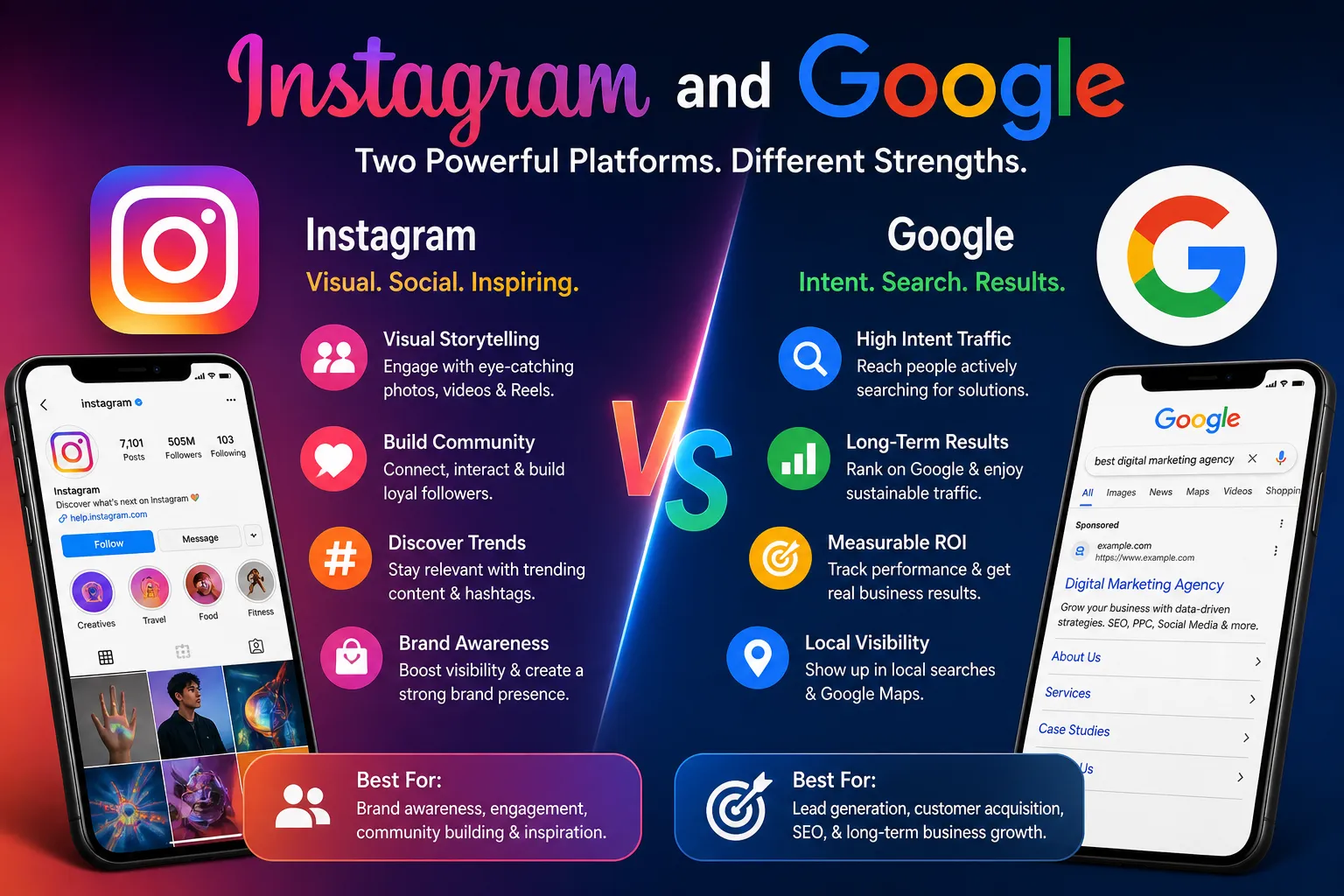
What emerged from those conversations, and from watching campaigns play out across different cities and budgets, was a clearer picture than the hype suggested. Neither Instagram nor Google stands alone as the winner. Each pulls a different kind of attention, rewards different kinds of effort, and carries its own quiet costs. The real edge belongs to those who stop treating them as rivals and start seeing them as separate languages spoken to the same person at different moments in his decision journey.
The Scent of Intention
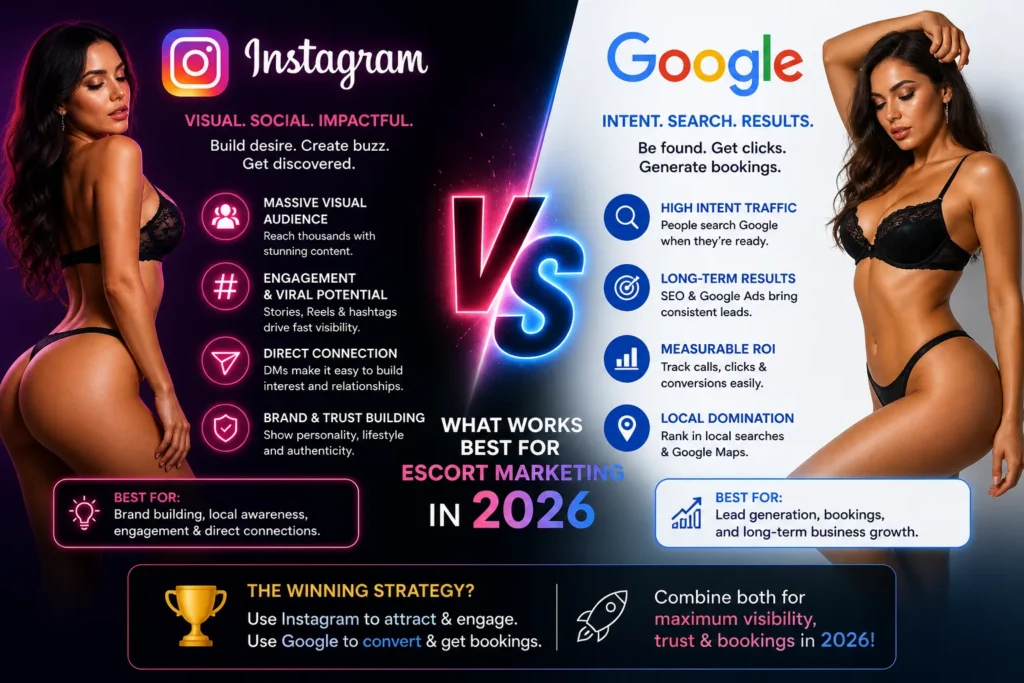
Google has always been the place where desire crystallizes into language. A man sitting alone after a long day types something specific—“discreet companionship Kensington evening” or a more coded variation that still carries weight. He isn’t browsing for entertainment. He’s expressing need with enough clarity that the search engine understands the weight behind the words. In 2026, that intent still matters enormously, perhaps more than ever as AI overviews and conversational search try to interpret what people really want before showing links.
The traffic that arrives through Google tends to convert at rates that make the higher cost per click feel less painful in hindsight. These visitors have already crossed a threshold. They’ve named their want. They’ve chosen privacy over public scrolling. For many providers, especially those offering genuine connection rather than quick encounters, this matters. A well-positioned website that loads cleanly on mobile, speaks with elegance instead of desperation, and respects the visitor’s need for discretion can close the distance fast.
Yet getting there demands patience and precision. Google’s policies around adult services remain strict, pushing operators toward softer phrasing—“luxury companionship,” “elite private arrangements”—while still needing to satisfy the algorithm’s hunger for relevance, speed, and user signals. Long-tail expressions, local nuances, and pages that feel lived-in rather than templated become crucial. A site that tells a coherent story about atmosphere, boundaries, and the texture of time spent together often outranks one that simply lists attributes.
I remember one independent in Edinburgh who redesigned her entire online presence after years of scattered directory posts. She worked with a team that understood both the technical side and the emotional one. The result wasn’t flashy. It was calm, fast, trustworthy. Within months, her organic visibility in relevant searches across Scotland improved noticeably. The inquiries that arrived carried a different tone—more considered, less window-shopping. That shift alone changed how she managed her calendar.
The Allure of the Scroll
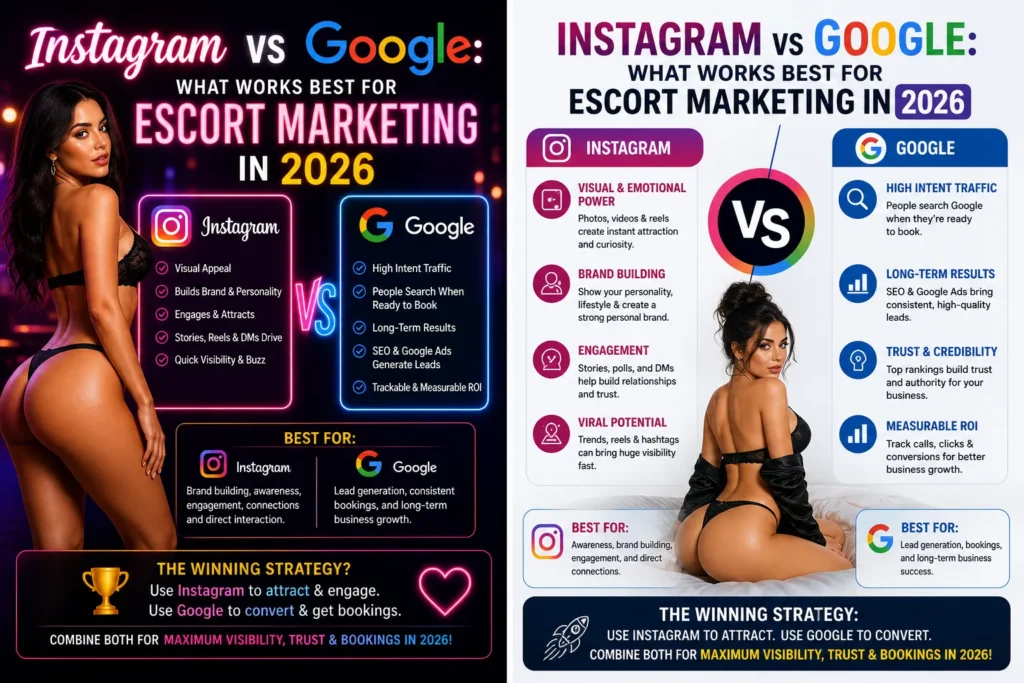
Instagram operates on an entirely different rhythm. Here, the encounter begins with mood rather than declaration. A carefully framed image, a short reel capturing the play of light across skin and silk, a story that hints at personality without revealing too much—these create the first spark. In a year when short-form video still dominated attention and users rewarded content that held their gaze past the first few seconds, the platform rewarded those who understood pacing and suggestion.
The UK audience on Instagram skews younger in parts, though not exclusively. Professionals in their late twenties to mid-forties scroll during commutes, late evenings, or stolen moments. They respond to beauty, to implication, to a sense of exclusivity that feels aspirational rather than overt. Hashtags, when chosen with care and restraint, still surface content to eyes that weren’t actively searching. Reels that tell micro-stories—perhaps the quiet ritual of preparing for an evening, or the texture of laughter shared—can travel further than static posts ever did.
But the platform’s relationship with adult-adjacent content remains uneasy. Shadow restrictions, sudden drops in reach, and the constant need to dance around explicit boundaries create a peculiar tension. Many operators I’ve spoken with describe pouring energy into content that performs well for a few weeks only to see distribution throttled without clear explanation. Direct links to booking often get stripped or flagged. Tracking the precise journey from a like to an inquiry requires sophisticated funnels—often involving encrypted messaging or discreet landing pages that don’t scream their purpose.
One agency owner in Birmingham shared how she used Instagram primarily as a mood board for her brand. The platform built recognition and curiosity among a certain demographic. When those curious minds later turned to Google with more specific phrasing, her website was ready to receive them. The combination felt less like competition and more like orchestration. Instagram planted the seed; Google helped the man act on it.
Where the Numbers Bend Reality?
By 2026, raw follower counts on Instagram meant far less than they once did. What mattered more was sustained watch time, shares sent privately through DMs, and the quality of saves. Content that encouraged someone to linger, to replay, to send a fragment to a friend with a quiet comment—that content gained distribution. Yet for escort marketing in the UK, translating that engagement into actual bookings demanded careful bridging. Many found themselves building private communities or using Stories as gentle nudges toward more direct channels.
Google, meanwhile, had grown more sophisticated in understanding user satisfaction. Sites that loaded slowly, that felt dated, or that failed to answer the visitor’s underlying questions quickly lost ground. Mobile experience became non-negotiable. So did clarity around availability, boundaries, and the emotional tone of the encounter. Providers who invested in photography that felt cinematic rather than clinical, copy that read like conversation rather than catalog, and structures that made navigation feel intuitive saw their positions stabilize even as algorithm updates rolled through.
The cost difference still stung. Instagram often felt cheaper at the surface level—organic reach, influencer collaborations, creative experiments. Google required deeper pockets for paid elements and ongoing technical attention for organic visibility. Yet when measured against actual client quality and repeat business, the math frequently tilted toward the search engine for those offering higher-end, more relational services. The scroll delivered volume and awareness; the search delivered readiness.
The Hybrid Pulse That Actually Works
The operators who seemed most at ease in 2026 weren’t purists. They treated the two platforms as different rooms in the same house. Instagram became the space for atmosphere and subtle discovery. Elegant visuals, restrained storytelling, occasional collaborations with lifestyle creators who understood discretion. The goal wasn’t immediate conversion but the slow cultivation of recognition and desire.
Google became the conversion layer. A website optimized not just for keywords but for the visitor’s state of mind—offering reassurance, elegance, and ease of next steps. Fast loading times even on variable UK mobile networks. Clear yet tasteful photography. Copy that acknowledged the humanity on both sides without descending into vulgarity or corporate stiffness. Pages that loaded with the same composure the provider hoped to bring to the meeting itself.
One particularly insightful escort I met in Bristol described her funnel this way: Instagram let her show fragments of her world—the books on her shelf, the way candlelight moved across a room, the quiet confidence in her posture. Those fragments lodged in memory. Later, when a man found himself with an evening free and a specific longing, he turned to Google. Because her brand had already made an impression visually and emotionally, her site felt familiar when it appeared in results. The trust curve shortened.
This hybrid approach demanded consistency. The visual language on Instagram needed to echo the tone on the website. The discretion promised in one place had to be delivered in the other. When the pieces aligned, the whole system felt less like marketing and more like an extension of the personal brand itself.
The Role of Craftsmanship Behind the Curtain
No discussion of effective escort marketing in the UK in 2026 feels complete without acknowledging the foundation that often determines long-term success: the website itself. A clunky, dated, or poorly structured site can undo months of careful image-building on social platforms. Conversely, a site that feels premium—secure, fast, thoughtfully designed, easy to navigate on any device—amplifies every pound spent elsewhere.
This is where working with the best escort web design agency in UK proves its value. Not the ones churning out identical templates, but those who listen to the unique voice and boundaries of each provider or agency.
They understand how to balance visual appeal with technical requirements that Google respects: clean code, proper structuring, mobile perfection, and subtle optimization that doesn’t trip compliance wires. They craft experiences that feel personal rather than mass-produced, pages that load instantly even when someone is checking discreetly on a train or in a hotel lobby.
I’ve seen the difference repeatedly. A provider who invested in proper web design reported that her Google visibility improved steadily even without aggressive paid campaigns. The site itself became a quiet salesperson—conveying professionalism, taste, and reliability before a single message was exchanged. In a landscape where first impressions happen in fractions of a second, that craftsmanship stops being optional.
The Human Thread Running Through the Machines
Beneath the algorithms and policy changes lies something more fundamental. Clients in 2026 still seek the same core things: connection without complication, beauty without performance pressure, discretion that actually holds. Platforms are merely the doors. The quality of what waits behind them determines whether someone knocks once or becomes a regular.
Instagram excels at sparking the initial flicker of interest, especially among those who discover through mood and aesthetics. Google captures the moment when interest turns into deliberate action. The most effective strategies I observed honored both moments without forcing one to do the work of the other.
There were practical lessons too. On Instagram, authenticity in small details—real environments, genuine expressions, hints of personality—outperformed overly polished perfection that felt manufactured. Watch time and private shares became stronger signals than public likes. On Google, relevance and user experience reigned. Sites that answered unspoken questions (safety, mutual respect, the actual texture of time together) performed better than those shouting attributes.
Regulatory realities added another layer. The UK’s emphasis on online safety and advertising standards meant creative restraint became a professional skill. Those who learned to suggest rather than state, to imply rather than expose, often navigated the terrain with fewer disruptions.
Looking Further Down the Corridor
As 2026 unfolded, the lines between platforms continued to blur in interesting ways. Google increasingly surfaced visual and social content within search results. Instagram experimented with more search-like discovery features. AI tools began summarizing options and shaping expectations before users even reached a website. The operators who thrived paid attention to the entire ecosystem rather than fixating on any single channel.
They also protected their energy. Marketing that consumed every spare hour left little room for the presence that actually sustained a client book. The smartest approaches were sustainable—consistent without frenzy, strategic without obsession.
For anyone navigating escort marketing in the UK right now, the question worth asking isn’t simply “Instagram or Google?” It’s closer to: How do I want to be discovered, and what kind of experience do I want waiting when someone takes the next step? The platforms are tools. The craft lies in using each according to its nature while ensuring the through-line—your presence, your standards, your particular way of creating connection—remains unmistakable.
The woman in Mayfair eventually built a balanced system. Instagram kept her visible to a wider circle in elegant, understated ways. Her website, refined with help from professionals who specialized in this exact niche, handled the serious inquiries with grace. The combination didn’t eliminate uncertainty, but it reduced the waste and sharpened the quality of her time.
In the end, marketing at this level isn’t about chasing algorithms. It’s about understanding human longing well enough to meet it where it surfaces—sometimes in the lazy scroll of an evening, sometimes in the deliberate search of a quiet moment—and then delivering an experience that feels worth the journey. The platforms will keep changing. The need for genuine connection, handled with intelligence and care, probably won’t.